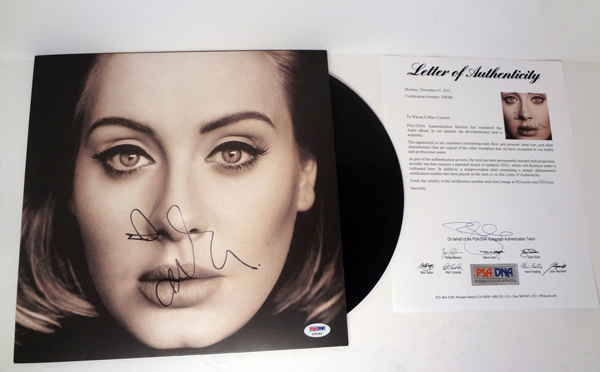
Vinyl has never really gone away, and in the autograph hobby it occupies a category all its own. A signed record combines two things collectors already care about deeply: a physical format with real cultural weight, and a direct connection to the artist who made it. Understanding what separates a great signed vinyl piece from an ordinary one helps you buy smarter, whether you’re adding to an existing collection or picking up your first record. Our Adele signed 25 vinyl record, shown above, is a good example of the format at its best; a signature from one of the best-selling artists of her generation on one of her most defining albums.
Why Vinyl Carries a Weight Digital Never Will
Streaming put music everywhere and, in doing so, made the physical album feel more significant rather than less. A vinyl record is tactile; it has a cover you hold, a sleeve you slide it out of, a label you read while it spins. When that same object also carries the artist’s signature, it becomes something closer to an artifact than a possession. Nothing about a digital file can replicate that.
This is part of why vinyl has become one of the strongest-performing categories in music memorabilia over the past several years. Collectors aren’t just buying a signature; they’re buying the specific physical object an artist chose to put their music on, which gives a signed record a kind of permanence that other formats don’t carry in the same way.
The Scarcity Factor: Deceased Artists and Vinyl
Every factor that drives autograph value generally applies to vinyl, but scarcity hits differently here. A deceased artist’s signature is permanently finite across every format they ever signed, but vinyl in particular tends to carry a premium because it was rarely the most common item at a signing. Photos and CDs were often easier to bring to an event; a full-size record album took more effort, which means fewer exist relative to other formats for many artists.
That imbalance compounds over time. As the overall supply of an artist’s signed material shrinks, the harder-to-find formats become disproportionately harder to find, and vinyl is frequently one of them. Our Aerosmith complete band signed Dream On vinyl record is a good example of this; a full-band signature that’s harder to come by than a single member’s autograph on the same album.
Where on the Record the Signature Sits
Not all signed vinyl is signed in the same place, and where the signature sits affects both the look of the piece and how it should be displayed. A signature on the album cover is the most common and the most display-friendly; it sits flat, frames well, and doesn’t require removing the record itself. A signature directly on the vinyl label, the small paper circle at the center of the disc, is less common and often considered more personal, since it means the artist signed the actual playing surface’s housing rather than the packaging around it.
Some collectors specifically seek out label signatures because they’re rarer; others prefer cover signatures because they’re easier to frame and display without disturbing the record inside. Neither is inherently more valuable than the other; it comes down to what a specific collector is looking for and how they plan to display the piece.
Framed Vinyl With a Signed Insert
A newer format gaining traction is framed vinyl built around a separate signed insert rather than a signature directly on the cover or label. In this format, the artist signs a dedicated insert card, which is then professionally framed alongside the actual vinyl record, giving the piece a gallery-ready presentation right out of the box. Our Lady Gaga signed Mayhem vinyl record, framed is a good example of this format.
This approach has a real practical advantage: the record itself stays untouched by the signing process, and the framing protects both the vinyl and the signed insert behind glass from day one rather than requiring the buyer to handle framing separately. For collectors who want their signed vinyl ready to hang the moment it arrives, this framed insert format is becoming an increasingly popular way to buy.
Condition Matters More With Vinyl
Records are more physically vulnerable than a photo or a book. Cover corners crease, seams split, and the vinyl itself can warp if stored incorrectly. All of this affects a signed record’s presentation and, over time, its condition grading. Storing vinyl vertically rather than stacked flat is the single most important habit for preventing warping, and keeping records out of direct sunlight protects both the artwork and the ink of the signature itself.
A record with a clean, unworn cover and a bold, undamaged signature will always be more desirable than the same signature on a worn or water-damaged copy, which is exactly why proper storage and display matter as much for vinyl as the signature itself.
Authentication on Vinyl Records
Vinyl is signed on paper and cardboard surfaces, which means it authenticates the same way any other paper-based item does. A tamper-evident holographic sticker is applied directly to the cover or label, with a unique certification number that’s permanently verifiable online. For a full walkthrough of how that verification process works, see our guide on how to verify a PSA/DNA certificate.
Given how vulnerable records are to handling damage, authentication matters even more here than it does for sturdier formats. A cert number gives you a permanent record of what the signature looked like at the time of authentication, independent of whatever happens to the physical item afterward.
Building a Vinyl Collection
If you’re new to collecting signed vinyl specifically, our beginner’s guide to collecting signed memorabilia covers the fundamentals that apply across every format. For vinyl in particular, the best approach is starting with artists and albums that already mean something to you personally; a signed record from a defining album in your own listening history will always be more satisfying to own than one chosen purely for scarcity or resale considerations. Our Billy Joel signed Piano Man vinyl record is a strong example of exactly that kind of piece; a signature directly tied to the song that defined an artist’s career.
Collect With Confidence
Every signed vinyl record at Nicks Sports Autographs is authenticated by PSA/DNA or Beckett Authentication with an individual cert number that is permanently verifiable. No exceptions. Our records span decades of music history across rock, pop, country, and beyond, and every order ships free within the United States.