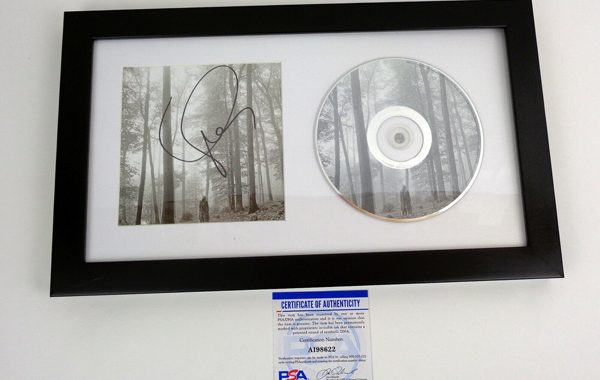
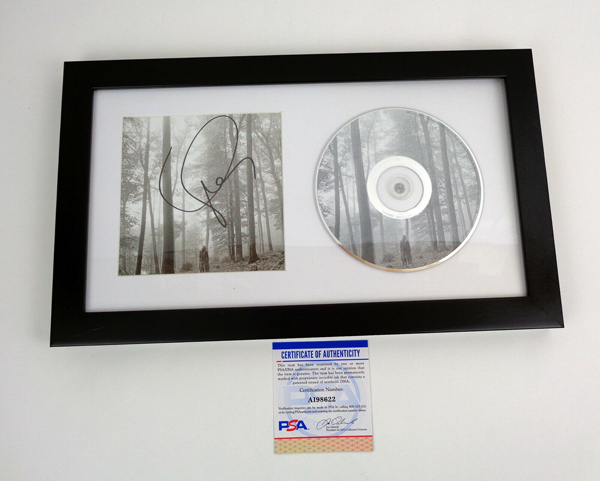
One of the first decisions every collector faces after buying a signed item is whether to frame it. It’s not always an obvious call; framing protects a piece and makes it display-ready, but it also costs money and, in some cases, isn’t even the right choice for the format you’re holding. Our Taylor Swift signed Folklore framed CD, shown above, is a good example of framing done right. Here’s how to think through that decision across the different types of memorabilia you’re likely to own.
Why Framing Matters
Beyond the aesthetics, framing is fundamentally a preservation decision. A properly framed piece is protected from handling, dust, and to some degree humidity, all of which are among the biggest threats to signed memorabilia over time. The key word is properly; a poorly framed piece using regular mat board and backing can actually do more harm than good, since standard framing materials contain acids that cause paper to yellow and deteriorate over years.
If you do frame a signed item, insist on acid-free or archival-quality matting and backing, and make sure the mat creates a gap between the signed surface and the glass so moisture can’t cause the ink to transfer. This is true regardless of what’s being framed; the standard doesn’t change based on the item’s value.
Photos and Posters: Frame Them
Signed photos and posters are the clearest case for framing. These formats are flat, lightweight, and highly vulnerable to bending, creasing, and light damage if left unprotected. Professional framing with acid-free materials is close to a requirement here rather than an optional upgrade; an unframed photo left leaning against a wall or stacked in a stack will degrade far faster than one behind glass.
CDs: Frame Them
Framed CDs have become one of the most popular formats in the hobby for a reason. The combination of album artwork and a visible signature makes for a genuinely striking display piece, and CDs are compact enough that framing them is inexpensive relative to larger formats. Unframed signed CDs also tend to get handled more, since the case alone doesn’t feel special the way a framed piece does, which increases the risk of accidental damage over time.
Vinyl Records: It Depends
Vinyl is the format where this decision gets more interesting. A traditional signed record, signed directly on the cover or label, can be framed, but it requires specialized deep-set framing that accommodates the record’s thickness, and many collectors prefer to keep the record itself accessible rather than sealed behind glass permanently.
A newer approach solves this tension directly: framing built around a separate signed insert rather than the record itself. In this format, the artist signs a dedicated insert card that’s professionally framed alongside the vinyl, giving you a gallery-ready piece while keeping the actual record protected and, in some cases, still playable. This framed insert format has been gaining real traction, and it’s worth considering specifically if you want the display appeal of framing without permanently altering how the record itself is stored.
Books: Leave Them Unframed
Signed books are one of the clearest cases against framing. A book is meant to be opened, and framing it defeats the format’s basic purpose while doing nothing to protect the pages you can’t see once it’s sealed behind glass. Instead, store signed books upright on a shelf away from direct sunlight, or flat in an acid-free sleeve if you’re not displaying it actively. A book stand can give a signed book visual presence on a shelf without the cost or permanence of framing.
Baseballs, Guitars, and Other Three-Dimensional Items: Use a Case, Not a Frame
Framing doesn’t apply to three-dimensional items at all; these need display cases instead. A clear acrylic case for a baseball, or a wall-mounted case for a guitar, achieves the same protective goal framing does for flat items: keeping dust, moisture, and handling damage away while still allowing full display.
Weighing Cost Against Value
Professional framing isn’t free, and it’s worth being intentional about which pieces justify the investment. A higher-value or particularly meaningful item in your collection is usually worth the cost of quality, archival framing. A lower-cost item you’re still deciding how you feel about might be better served sitting in an acid-free sleeve until you’re certain you want to commit to framing it. There’s no rule that says everything needs to be framed immediately; protecting an item properly matters more than framing it right away.
The Bottom Line
Frame flat items that benefit from display and protection: photos, posters, and CDs. Consider a framed insert for vinyl if you want display appeal without altering the record itself. Skip framing for books, and use a proper display case rather than a frame for anything three-dimensional. Whatever you choose, the goal is the same across every format: protect the piece without compromising what makes it worth owning in the first place.
Display With Confidence
Every signed item at Nicks Sports Autographs is authenticated by PSA/DNA or Beckett Authentication with an individual cert number that is permanently verifiable. No exceptions. Many of our items are available pre-framed and ready to display, and every order ships free within the United States.